Build Your Own Search Engine
Continue with the workshop writeup
Open the canonical pages, recording, materials, and code repo.
We build a search engine from scratch over DataTalks.Club Zoomcamp FAQ
documents. We start with TF-IDF text search, then add cosine similarity and
field boosting. From there we move through SVD/LSA and BERT embeddings to
vector search. The TextSearch class built during the workshop became the basis
for the minsearch library
used in later RAG and agent workshops.
What we cover:
- TF-IDF text search with sklearn, cosine similarity, field boosting and keyword filtering
- A reusable
TextSearchclass that becomes minsearch - Vector search using SVD and NMF embeddings
- BERT embeddings for semantic search that respects word order
Originally delivered at a DataTalks.Club live session in 2024, updated in 2026 with refreshed examples and tooling.
Links
Resources not included in the workshop materials list:
The search engine you will build
We take two approaches to search over the same FAQ data:
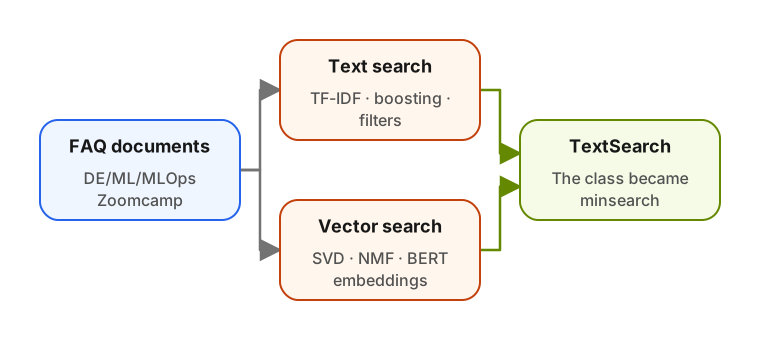
Text search uses TF-IDF vectorization, weights the question field three
times as much as the others, and filters by keyword. Vector search replaces
sparse representations with dense embeddings (SVD, NMF, then BERT) to handle
synonyms and word order. Both paths share the TextSearch class we build
along the way, which combines TF-IDF across multiple fields with boost weights
and keyword filters.
Hosted by

Alexey Grigorev
Chief Agent Officer at AI Shipping Labs
Software engineer and machine learning practitioner with 15+ years of experience building production ML systems. I focus on practical, production-grade ML and AI systems, from early prototypes to reliable systems in production.
I'm the founder of DataTalks.Club, a free community that connects tens of thousands of practitioners worldwide, and the creator of the Zoomcamp series, free, code-first programs that have reached 100,000+ learners globally.
At AI Shipping Labs, I'm building the kind of environment that would have accelerated my own career growth. After years of teaching at scale, I wanted something more focused: a space for action-oriented builders who want to turn AI ideas into real projects. The community gives members the structure, accountability, and peer support to ship practical AI products consistently, even alongside their main jobs.
Related content
Build a Documentation RAG Agent with Search Tools
We build a RAG system over real documentation and evolve it into an agentic search flow. For the knowledge base we use the Evidently AI documentation, a real set of Markdown files…
May 4, 2026
Build a Course FAQ Agent with MCP, PydanticAI and OpenAI
We build a course FAQ assistant from the bottom up. First we expose a plain Python search(query) function to the OpenAI Responses API. Then we turn the same idea into a reusable a…
September 1, 2025
AI Engineering Buildcamp: From RAG to Agents
A hands-on course on building production AI applications with large language models: retrieval-augmented generation (RAG), structured output, AI agents, testing, monitoring, and e…